


13/03/2010
Simulacrum
"The simulacrum is never that which conceals the truth--it is the truth which conceals that there is none. The simulacrum is true." - Baudrillard
In his treatise, Simulacra and Simulations, Jean Baudrillard hypothesized that we (as a modern society) no longer live in the real world, but rather, a simulated version that has become more real than reality.
In his treatise, Simulacra and Simulations, Jean Baudrillard hypothesized that we (as a modern society) no longer live in the real world, but rather, a simulated version that has become more real than reality.

09/03/2010
Situationism
S.I., or Situationist International began in 1957 with the merge of Guy Debord's Lettrist International and Asger Jorn’s International Movement for an Imaginist Bauhaus.
Situationist International references Fururism, Dada and Surrealism in its contextualisation, and the manifesto laid out forms part of a utopian anti-art tradition that are influenced by these movements themselves.
"The SI has a reputation for scandal and subversion. Its political theories made popular by punk rock were a blend of Marxism and anarchism. In spite of this the SI condemned both communism and anarchism for their failings. They criticised modern consumer society for alienating people and turning their lives into meaningless pursuits of commodities." -Karen Elliot 1999
On Detournement - http://www.bopsecrets.org/SI/detourn.htm
Detournement in the words of Situationist International, ‘there is no Situationist art, only Situationist uses of art.’
Detournement is distinctly different theft plagiarism "which only subverts the source of the material and post-modern ‘ironic quotation’ plagiarism which only subverts the meaning of the material, the source becoming the meaning. The SI used detournement in films, art, graphics for their journal and in posters that detourned comics during the events of May ’68." (Elliot 1999)
Guy Debord as key to SI, the only member to stay with it for its duration. Georg Lukacs gave the SI the idea of reification, which he meant to mean a form of objectification where the relationships between things replaces the relationships between people. Debord was interested in freeing people from the alienation of work, commodity fetishism and money, he wanted people to experience everyday life without alienation - ‘man must be everyday, or he will not be at all.’
Debord wrote 'The Society of the Spectacle' (1967) extending the idea of reification where where what ‘was directly lived has moved away into a representation’.
"The spectacle is not the domination of the world by images or any other form of mind-control but the domination of a social interaction mediated by images. Reification separates people from one-another but the spectacle is a unifying principle of society where it ‘reunites the separate, but reunites them as separate’." ( Eliott 1999)
The Spectacle generates passivity in its spectators, as made evident in the
SI essay ‘The Spectators Of Suicide’. "The spectacle forces people into stereotypes and roles especially through the specialisation of labour (you are your job and the things you consume) The spectacle presents a false view of the world where ‘the liar has lied to himself.’"
Situationist International references Fururism, Dada and Surrealism in its contextualisation, and the manifesto laid out forms part of a utopian anti-art tradition that are influenced by these movements themselves.
"The SI has a reputation for scandal and subversion. Its political theories made popular by punk rock were a blend of Marxism and anarchism. In spite of this the SI condemned both communism and anarchism for their failings. They criticised modern consumer society for alienating people and turning their lives into meaningless pursuits of commodities." -Karen Elliot 1999
On Detournement - http://www.bopsecrets.org/SI/detourn.htm
Detournement in the words of Situationist International, ‘there is no Situationist art, only Situationist uses of art.’
Detournement is distinctly different theft plagiarism "which only subverts the source of the material and post-modern ‘ironic quotation’ plagiarism which only subverts the meaning of the material, the source becoming the meaning. The SI used detournement in films, art, graphics for their journal and in posters that detourned comics during the events of May ’68." (Elliot 1999)
Guy Debord as key to SI, the only member to stay with it for its duration. Georg Lukacs gave the SI the idea of reification, which he meant to mean a form of objectification where the relationships between things replaces the relationships between people. Debord was interested in freeing people from the alienation of work, commodity fetishism and money, he wanted people to experience everyday life without alienation - ‘man must be everyday, or he will not be at all.’
Debord wrote 'The Society of the Spectacle' (1967) extending the idea of reification where where what ‘was directly lived has moved away into a representation’.
"The spectacle is not the domination of the world by images or any other form of mind-control but the domination of a social interaction mediated by images. Reification separates people from one-another but the spectacle is a unifying principle of society where it ‘reunites the separate, but reunites them as separate’." ( Eliott 1999)
The Spectacle generates passivity in its spectators, as made evident in the
SI essay ‘The Spectators Of Suicide’. "The spectacle forces people into stereotypes and roles especially through the specialisation of labour (you are your job and the things you consume) The spectacle presents a false view of the world where ‘the liar has lied to himself.’"
08/03/2010
Dada/Fluxus
Dada belongs to everybody. Like the idea of God or the toothbrush ... Dada existed before us (the Holy Virgin) but one cannot deny its magical power to add to this already existing spirit.
-Tristan Tzara, "Authorization, New York Dada," New York, 1921.
Long, long ago, back when the world was young ... Fluxus was like a baby whose mother and father couldn't agree on what to call it ... Fluxus has a life of its own ... When you grow up, do you want to be a part of Fluxus? I do.
-Dick Higgins, "A Child's History of Fluxus," New York, 1979.

-Tristan Tzara, "Authorization, New York Dada," New York, 1921.
Long, long ago, back when the world was young ... Fluxus was like a baby whose mother and father couldn't agree on what to call it ... Fluxus has a life of its own ... When you grow up, do you want to be a part of Fluxus? I do.
-Dick Higgins, "A Child's History of Fluxus," New York, 1979.
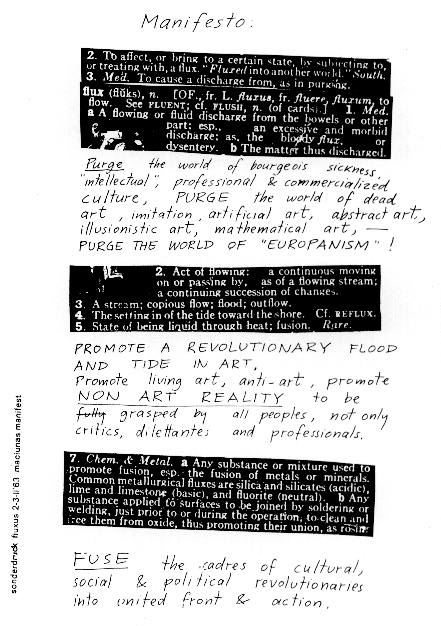
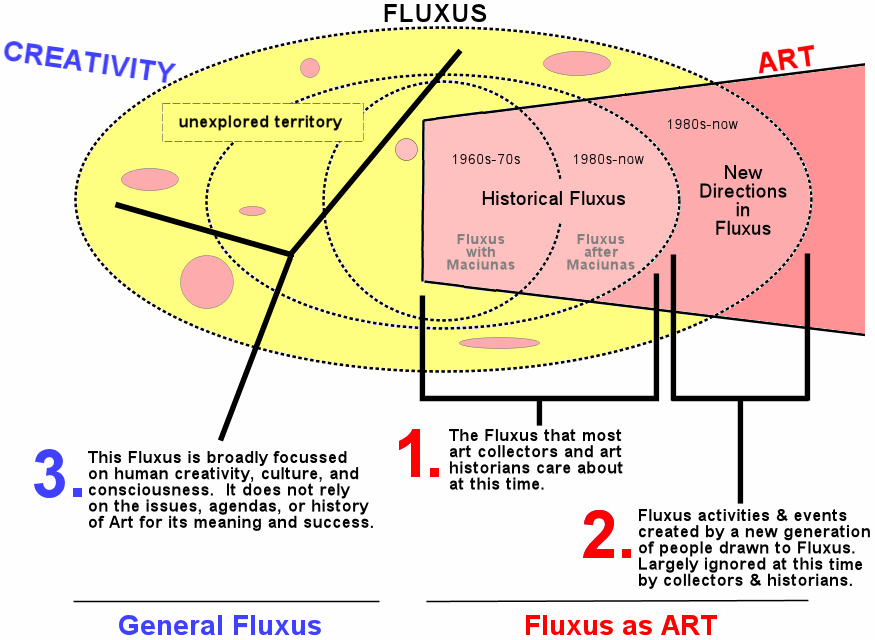
Fluxus pt 2

Fluxus “happens when one feels that life and art must be taken so seriously, that it becomes impossible to take life or art seriously.”
1) Fluxus makes the mundane magical.
2) Fluxus happens when one feels that life and art must be taken so
seriously, that it becomes impossible to take life or art seriously.
3) Ordinary acts and ordinary objects perceived in extraordinary ways
Alternative Space & Redux.
Redux and the organisation of dirt.
Questioning notions of typical gallery space, a reconstruction of Giorgio Sadotti's Dinner Party, originally held at Cubitt Street Gallery in 1996.
"®edux re-presented the event with different guests and performance, in a setting whereby the guests were part of the performance. The unnerving quality of these power brokers in an alternative ‘dirty’ space, set the agenda for subsequent events, and a radical approach to how exhibitions are set in terms of art world etiquettes of behaviour." -Peter Lewis
Questioning notions of typical gallery space, a reconstruction of Giorgio Sadotti's Dinner Party, originally held at Cubitt Street Gallery in 1996.
"®edux re-presented the event with different guests and performance, in a setting whereby the guests were part of the performance. The unnerving quality of these power brokers in an alternative ‘dirty’ space, set the agenda for subsequent events, and a radical approach to how exhibitions are set in terms of art world etiquettes of behaviour." -Peter Lewis
What is curating?
-How do we formalise something which is an informal practise?
-Theory and practise - impacts as variegated and dependent upon interests of intended 'group'.
-Perspectives in curating.
-Alternative curatorial practises, concerning IDEAS OF REPRESENTATION OF OBJECTS OUTSIDE THE SPHERE OF THE MUSUEM SPACE.
-Theory and practise - impacts as variegated and dependent upon interests of intended 'group'.
-Perspectives in curating.
-Alternative curatorial practises, concerning IDEAS OF REPRESENTATION OF OBJECTS OUTSIDE THE SPHERE OF THE MUSUEM SPACE.
Beyond 'Beyond Interface': Art in the Age of Ubiquitous Networking - Medialab-Prado Madrid
Beyond 'Beyond Interface': Art in the Age of Ubiquitous Networking - Medialab-Prado Madrid
In the now-historicized first epoch of net.art, the Internet was a para-site for the protocols and viruses of a new form of art. net.art proposed radical shifts in the production and reception of art, and to a significant degree these parallel tracks purported to converge on the horizon of the Interface in a participatory consumation of artist and audience. A funny thing happened on the way to this future, however. It kept receding. Into new devices. New metaverses. Into ubiquity, arguably.
... the notion of art in an age of ubiquitous networking and whether this constitutes a second epoch of net art or network practice or something else. Art after networks?
In the now-historicized first epoch of net.art, the Internet was a para-site for the protocols and viruses of a new form of art. net.art proposed radical shifts in the production and reception of art, and to a significant degree these parallel tracks purported to converge on the horizon of the Interface in a participatory consumation of artist and audience. A funny thing happened on the way to this future, however. It kept receding. Into new devices. New metaverses. Into ubiquity, arguably.
... the notion of art in an age of ubiquitous networking and whether this constitutes a second epoch of net art or network practice or something else. Art after networks?
Caroline Langill, Shifting Polarities : Electronic media in 1974

Vera Frenkel, String Games: Improvisations for Inter-City Video, 1974-2005
Radical Diversity - the confluence of art and the Internet - Medialab-Prado Madrid

Radical Diversity - the confluence of art and the Internet - Medialab-Prado Madrid
Current, popular definitions of net art do not describe the plurality of approaches and methods artists have used and still use. They have become limiting obstacles that block our view of this wonderfully complex terrain of mixed conceptual and material art practices. Mainstream art discourse generally fails when assessing net art by confusing it with web art. At the basis of this misinterpretation lies a lack of knowledge of even the basics of new media.
...we should not follow such temporary projections and misinterpretations. By escaping from the trap of fitting ourselves into any net art cliché we have the chance to re-evaluate both past and present art practices. This re-evaluation needs to include a proper interdisciplinary approach, which reaches beyond a purely literary, conceptual art criticism.

The Internet and Art.
Interesting article by Jon Ippolito.
The internet is such a rapidly growing and influential element of contemporary culture. How do we explore the internet as a medium for art? Can it function as a process for making art or is it merely a platform for display and curation.
The internet is such a rapidly growing and influential element of contemporary culture. How do we explore the internet as a medium for art? Can it function as a process for making art or is it merely a platform for display and curation.
07/03/2010
06/03/2010
Context Responsive Curation:
The Organisation of Dirt.
'An assumption that traditional approaches to visual display are inadequate in the context of marginal, orphaned, ephemeral, and raw spaces'.
The curation of ideas as well as spaces.
'An assumption that traditional approaches to visual display are inadequate in the context of marginal, orphaned, ephemeral, and raw spaces'.
The curation of ideas as well as spaces.
Subscribe to:
Comments (Atom)