11/05/2010


07/05/2010
An exploration of the contemporary space(s) of the internet.
The internet is such a rapidly growing and influential facet, and space, of contemporary culture, how do we then explore it in relation to art and curation? It has been analysed since its beginnings by net.artists, and initially struggled to be accepted as a serious art institution. Can the internet function as a process, or is it merely a platform for display and curation? For the purpose of this essay it is crucial to consider the inheritances of the internet, specifically in relation to the movements of Situationism and Fluxus. Another element to be critically analysed is the notion of the internet as a modern space - although not a space of 'modernism - and how ultimately this relates to Bourriauds idea of the 'altermodern' and a rejection of historical linearity.
Bourriaud, in his treatise 'altermodern', asserts that post-modernism is redundant, that it was purely the in-between phase at the end of the 19th Century as art mourned the natural end to its static perception of itself. Altermodernism is art reacting to its situation in relation to developing notions of global culture. Bourriaud rejects conventional historical narratives instead, he elucidates - art in the altermodern is a 'positive experience of disorientation through an art form exploring all dimensions of the present, tracing lines in all directions of time and space.' (Bourriaud, 2009). ). The corresponding exhibition, also entitled 'Altermodern', sought to supplement the ideas contained within his theory. It presented art works which were demonstrative of this concept of the 'cultural nomad', the art focusing on notions of displacement and dislocation, 'voyages, objects and beings - in migration' (post.thing.net, 2010). It is arguable that within works considered 'altermodernist', the idea of displacement is not a uniting aesthetic, rather it becomes a methodology and a view point which 'exist in a peripheral, yet significant network of relationships by which the artist then elaborates on' (post.thing.net, 2010). If we consider the internet in its base form, a – global – network, we can consider it as archetypal of the fundamental essence of the altermodern, rendering time and space and the dimensionalities of these concepts, archaic.
Regardless of altermodernist theory and the rejection of historical narrative (which arguably, the net enables), it is interesting to consider the development of the internet and net art. Situationism and Fluxus are significant to consider in this capacity, especially as Fluxus artists' in the 1960's were amongst some of the first to experiment with 'new media' arts (as a result of the development of video technologies) that were the predecessors of the new media art we recognise in the present. Situationist International references Futurism, Dada and Surrealism in its contextualisation, and the manifesto laid out forms part of a utopian anti-art tradition that is influenced by these movements themselves. Debord, in 1957 stated,
'Our central idea is the construction of situations, that is to say, the concrete construction of momentary ambiences of life and their transformation into a superior passional quality. We must develop a systematic intervention based on the complex factors of two components in perpetual interaction: the material environment of life and the behaviours which that environment gives rise to and which radically transform it.' (Debord, Report on the Construction of Situations [1957])
Situationism and Fluxus are philosophical and artistic movements contemporaneous with the rise of capitalism and mass produced consumer culture. Fluxus was concerned with creating movement in art, instead of the staid rigidity that they viewed 'modernism' as being synonymous with. In some respects it is wrong to consider Fluxus as a 'movement' per se, there was no unified 'fluxist' aesthetic, rather it provided the artists with a 'forum, free from the entanglements of the art establishment, in which to perform their own works, and the works of kindred spirits' (Williams, 1993). Situationism essentially concerned itself with creating 'situations' and arriving at new experiences, experiences not restricted by the ideological conditioning of a standardised consumer capitalist society. It 'criticised modern consumerist society for alienating people and turning their lives into meaningless pursuits of commodities.' (Elliot, 2001). Debord commented on the 'specularisation of society', a critique on the 'politics of the image' and a condemnation of 'market commerce art'. In his text, 'La Société du spectacle', Debord extends Marx's theories of Alienation to contend that 'the spectacle is not a collection of images; rather, it is a social relationship between people that is mediated by images'. (Debord, Society of the Spectacle, 1967). Aserger Jorn, further expanded upon Debords' 'construction of Situations' to introduce the concept of 'Situgraphology' (the study of situations) as a critique of Marxism. The difference between Marxism and Situationism or Fluxus is that where Marxism took the fundamentals of politics and the economy for affecting change, Situationism and Fluxus were more concerned with revolution of a cultural nature.
In relation to the internet, we have to consider whether the format of it, in itself, only reinforces Debords' idea of the spectacle. Is the internet the ultimate form of a contemporary spectacle? Or is it indeed the tool that Situationism needed to truly act subversively? If we consider the spectacle in the terms Debord describes; yes, the internet can be seen as functioning as representational, in terms of collating and disseminating imageries. Although as Debord contends, 'the spectacle in general, as the concrete inversion of life, is the autonomous movement of the non-living' (Debord, 1967) – can we really regard the internet in this manner? Surely, as the internet is such a rapidly evolving tool, it cannot be described as autonomous and spending too long trying to contextualise and situate net art in terms of its historical referents is decidedly futile. The internet goes further than to simply function as a representation of culture, in its own right it is another sphere or space of modern life, albeit a virtual one. In the past decade the internet has undoubtedly become an integral part of wider popular culture, and influential upon individual human experiences. Debord maintains the spectacle as being 'the opposite of dialogue' (Debord, 1967), debatably this is the true function of the internet – the creation of a global dialogue. The concept of globalisation was precipitated by the internet. Time and space, effectively became compressed and everything was, theoretically, instantaneously accessible; 'international distance is now represented by a progress bar' (Faculty Of The Arts Thames Valley University, 2007).
The Situationist theories of Derive and Detournment stem from Baudelaire's concept of the flâneur and are pertinent to investigations of the internet and its relations to society and art production. It is interesting to question the function of the internet in relation to these concepts, are they ideologically inter-relatable? Baudelaire saw the flâneur as playing a vital role in the understanding and development of the city. The notion of the flâneur has arguably 'accumulated significant meaning as a referent for understanding urban phenomena and modernity'. (Davidson, 2009). Baudelaire depicts the flâneur as perusing the modern city and finding awe in his surroundings. If we take the Situationist concept of 'psycho-geography' and apply it to the models of the internet, can we not see the potential for the Internet as a modern architectural space? As a forum for contemporary enactments of 'derive' and enabling the 'flâneur' in the present? The inherent architectural nature of the internet allows us to apply, to this virtual space, the 'nomadic' precepts of detour originally applied to urban spaces. New Babylon, as designed by Constant Nieuwenhuis in 1959-74(see Fig 1) depicts a utopian anti-capitalist city. Can we consider the internet as the embodiment of some of the principles behind Nieuwenhuis' utopia? As the form his designs for an alternative city-space would have taken, had the technology been available?
'The culture of New Babylon does not result from isolated activities, from exceptional situations, but from the global activity of the whole world population, every human being, being engaged' (Nieuwenhuis, 1974). Archetypal
Nieuwenhuis further contends that the physicality of a multi-layered city is the only conceivable form within which 'New Babylon' can exist – but surely this is exactly the kind of space offered by the net. If we take Bourriauds theory of the altermodern and the concept of the redundancy of historical narrative, can we not also argue that our conception of space and boundaries and layers is thus made redundant by the net – if the net is indeed paradigmatic of altermodernism and not post-modernism . Although, it is debatable whether or not the internet is in fact as 'utopian' as some might argue. Idealistically the internet would function thusly, although in reality the internet is bound by the same laws and regulations as real-space. William Gibson coined the term 'cyberspace' to describe a terrain which only varies from that we know in reality, by the very fact that it is a construction of a cyber-reality, a virtual extension of humanity.
Regardless of whether or not the internet functions in relation to the philosophies of Situationism and Fluxus, it is important to explore the potentiality of the internet in terms specifically related to art. The internet as a vehicle for art is rapidly gaining pace and structure. We can see the internet as operating as a virtual gallery. This very notion subverts hegemonic conceptions of gallery space and the traditional white cube approach to curation. Works of art are made accessible to those who wouldn't typically visit, or feel they know enough about art to visit a traditional space. Thus the internet, as a network, functions to open up art to a wider audience. Art in the age of networks is an issue which, at the moment is only addressed effectively by the forms New Media art takes in correlation with the net. Effectively the internet, as a network, allows us to transcend global-space. 'As a tool, networks allow us to communicate synchronously and asynchronously...they have become a vehicle for artistic practise' (Faculty Of The Arts Thames Valley University, 2007). In 'Curating Subjects', Carlos Basualdo discusses the 'unstable institution' and the concept of the revisions undergone by these 'institutions' as a result of the 'globalising contemporary art scene's networks' (Basualdo, 2007). He examines the importance of 'biennials', and 'large international exhibitions' - as art that is 'independent from commercial galleries and collectors' (Molnár, 2004). We can see these networks as operating much in the same way as the internet – but that the internet simply functions on a more decidedly 'global' scale.
We have to consider its possibilities extend further than merely being a tool with which galleries and artists can simply upload works of art. By the time the mainstream art world had become aware of the internet in the 1990's, Net art was already exploring and experimenting with this 'new landscape'. 'Art on this electronic frontier - known variously as Internet art, online art, or Net art - matured at the same breakneck pace with which digital technology itself has expanded.' (Ippolito). The 2009 piece 'YouTube as a Sculpture' (see Fig. 2), by Constant Dullaart, is an example of an artist exploring the workings of the internet and bringing it into the physical sphere of gallery space. Lighting, moving around large white orbs arranged in a circular shape, imitates the YouTube loading icon. The sculpture serves to highlight the dialectics of the 2D space of the internet and the 3D space of a gallery. The viewer is able to engage not only with the aesthetic of the work itself, but also with the mechanical processes of the piece. The projectors and other technical equipment are clearly visible and the audience is able to navigate around the sculpture itself, contrasting the inherent hidden nature of the codes of the net and concealed identity that it permits. As well as exhibiting the work as a gallery piece, Dullaart also uploaded a video of the installation onto YouTube itself. This then extended the dialogue back to the internet, the dissemination bringing focus back to the issues of communication and collaboration, and arguably the piece is only fully realised by its translocation into the realms of the internet. The intent of this piece is not to highlight the discord between the two forums for display, but rather the shared imagery serves to underscore the now inextricable relationship between the two. As stated in 2006, by the Taschen published 'New Media Art', 'as the boundaries separating New Media art from more traditional forms, like painting and sculpture, grow less distinct, New Media art will likely be absorbed into the culture at large' (Tribe & Jana, 2006).
Baudrillard, in his book 'Why hasn't everything disappeared yet?' prevaricates upon the inevitability of disappearance. He expands upon Heidegger's polemic 'The Question Concerning Technology' which raises the issue of technology confusing the boundaries of what is real and what is virtual. These issues are becoming increasingly germane as New Media art becomes 'absorbed into culture' and culture becomes absorbed into New Media art and the virtual and visual space of the internet.
Like the loading icon in 'Youtube As A Sculpture', the process of cultural production and collective understanding of the Internet's impact is unending, and carries expectancy and suspense. With the integration of online culture and Internet-related topics into the space of the commercialised art world, the potential for dialogue, creativity, and increased understanding of community and individuality is astounding. The dialogue between Internet and art will continue to evolve, to examine - as art does, the human impact of changing technologies, in ways that cannot be foreseen. By using the gallery space and physical art objects as a way of referring back to work created on the Internet and Internet culture, contemporary art could be said to be going further to reinforce the Internet's dominance of our reality, but the transience and temporality this brings to works is necessary if art is going to continue to compete culturally with the rapidly changing entertainments and ideas of the Internet, that are able to adapt far faster than traditional art forms.
Fig. 1
Symbolische voorstelling van New Babylon (detail) (Symbolic Representation of New Babylon), 1969, collage on paper, 55×60".
Fig. 2
Constant Dullaart, You Tube As A Sculpture. 2009.
Bibliography
Basualdo, C. (2007). The Unstable Institution. In P. (. O'Neill, Curating Subjects (pp. 39-52). London: Open Editions.
Baudrillard and Heidegger. (2009, November). Retrieved April 29, 2010, from i-network-world: http://inetworkworld.tumblr.com/post/202367401/baudrillard-and-heidegger
Berman, M. (1982). Modernism in the Streets. In All that is Solid Melts into Air: The Experiance of Modernity (pp. 131-171). New York: Penguin.
Bourriaud, N. (2009). Altermodern. London: Tate Publishing.
Davidson, T. (2009, August 15). Modern Flaneurs. Retrieved April 30, 2010, from Taylor Davidson: http://www.taylordavidson.com/writing/2009/08/15/flaneur/
Debord, G. (2006). Report on the Construction of Situations [1957]. In K. Knabb, Situationist International Anthology. California: Berkeley.
Debord, G. (1967). Society of the Spectacle. Retrieved March 2010, from Marxist Internet Archive: http://www.marxists.org/reference/archive/debord/society.htm
Dullaart, C. You Tube As A Sculpture.
Elliot, K. (2001, June 1). Situationism in a nutshell. Retrieved April 2010, from Barbelith Webzine: http://www.barbelith.com/cgi-bin/articles/00000011.shtml
Faculty Of The Arts Thames Valley University. (2007). Internet and Network Art; Artistic Explorations in Contemporary Internet Culture. Retrieved April 23, 2010, from ellington: http://ellington.tvu.ac.uk/ina/
Gergen, K. J. (2000). The Saturated Self: Dilemmas of Identity in Contemporary Life. New York: Basic Books.
Gibson, W. (1984). Neuromancer. New York: Ace.
Goldhagen, S. W. (2006). On Architecture. The New Republic .
Holmes, B. (n.d.). The Flexible Personality: For a New Cultural Critique. Retrieved May 7, 2010, from http://www.16beavergroup.org/brian/
Ippolito, J. (n.d.). Ten Myths of Internet Art. Retrieved April 10, 2010, from The New York Digital Salon: http://www.nydigitalsalon.org/10/essay.php?essay=6
Lewis, P. (2010). The Organisation of Dirt. Retrieved April 14, 2010, from Hub pages: http://hubpages.com/hub/peterlewisblog_organisationofdirt
Marchart, O. (1997, November 19). The Flaneur and his Duck; Towards a Discourse-Theoretical Analysis of (Cyber-)Spatiality. Retrieved March 10, 2010, from Net Time: http://www.nettime.org/Lists-Archives/nettime-l-9711/msg00022.html
Michelet. (2008). writes "Chaque époque rêve la suivante in Avenir! Avenir!, Europe 19 no 73 (January 15, 1929). In W. Benjamin, "Paris, the Capital of the Nineteenth Century," - The Work of Art in the Age of Its Technological Reproducibility (p. 97). Cambridge: Harvard University Press.
Mitchell, W. (1995). City of Bits. Space, Place, and the Infobahn. London: Cambridge.
Molnár, E. (2004, June 7). Carlos Basualdo: The Unstable Institution, an introduction. Retrieved May 1, 2010, from exindex: http://exindex.hu/index.php?l=en&page=3&id=250
Netherlands Media Art Institute. (2009, November 28). Versions. Retrieved April 10, 2010, from Netherlands Media Art Institute: http://www.nimk.nl/en/agenda/detail_agenda.php?id=326&archief=
Nieuwenhuis, C. (1974). New Babylon, A Nomadic Town. Retrieved April 2010, from Not Bored: http://www.notbored.org/new-babylon.html
post.thing.net. (2010). Deriving Knowledge - Altermodern, TATE Triennial . Retrieved April 3, 2010, from post.thing.net: http://post.thing.net/node/2568
Schavemaker, M., & Rakier, M. (2007). Right About Now: Art & Theory since the 1990's. Amsterdam: Valiz.
Tomkins, R. (2003). Happy Birthday Globalisation. Features; Financial Times .
Tribe, M., & Jana, R. (2006). New Media Art. Taschen.
Varnelis, K. (2009). The Immediated Now: Network Culture and the Poetics of Reality. Retrieved May 3, 2010, from networked, a (networked_book) about (networked_art): http://varnelis.networkedbook.org/the-immediated-now-network-culture-and-the-poetics-of-reality/
Williams, E. (1993). Happy Birthday Everybody. In N. Hodges, & R. Khambatta, Fluxus: Today and Yesterday. London: Academy Editions.
05/05/2010

Thomson & craigshead - Several Interruptions
'The Arts Council of England’s commissioning of Thomson & Craighead’s piece Several Interruptions for the relaunch of their website in 2009 . Thomson & Craighead, artists famous for their work on bringing Internet art to a gallery space, are known for creating pieces from appropriated online material, to ‘explore how technology changes the way we perceive the world around us’ . That the Arts Council sought the support of Thomson & Craighead’s reputation to promote the council’s own activity can be considered proof that Internet art is gaining acceptance as a legitimate artistic practise, even if it is not widely known as an art form by the public.
Several Interruptions (2009) utilises the popular Internet art tool of video collage to comment on the individual’s relation to the culture of Youtube. The piece is composed of three screens of individuals holding their breath underwater, with each set of videos interrupting the one before, until the fifth set where the subjects are shown finally breathing. Several Interruptions ‘make reference to the large-scale, three-screen projection installations of internationally-known video artists.’ This formal composition allows the ‘seemingly mundane and numerous’ Youtube videos , to be ‘made back into something unique and original.’ The artists’ transformation of the footage allows the name of ‘art’ to be given to performances made by individuals on the internet'
youtube disco
Dullaart’s Youtube Disco (2008) a video created by images of the Youtube play button changing colours to a constant rhythm, which was also showcased on art blogs, follows a similar theme. However, Youtube Disco existed only on the internet, and Youtube As A Sculpture reached an amount of viewers similar to this earlier piece in a far shorter space of time, illustrating the significant visual appeal of the transference of internet imagery to a 3d reality, and the artistic appeal of analysing the ideas and conflicts of the internet culture in a gallery space.
03/05/2010
The Flaneur and his Duck 1/2
<nettime> The Flaneur and his Duck 1/2
The Flaneur and his Duck
Towards a Discourse-Theoretical Analysis of (Cyber-)Spatiality
by Oliver Marchart
'Let us space.'
Jacques Derrida
The Flaneur and his Duck
Towards a Discourse-Theoretical Analysis of (Cyber-)Spatiality
by Oliver Marchart
'Let us space.'
Jacques Derrida
16/04/2010
...interventionist art
Interventionist art is concerned with either entering into a dialogue with a pre-existing art piece, or engaging with a situation outside of the art world in order to raise awareness/effect change, and often functions subversivly. It is commonly considered under the umbrella of conceptual art and often manifests itself in the form of performance.
Intervention art is fully recognised as a valid form of art, although interventions which go unsanctioned raise issues of vandalism and a discourse of the distinction between art/vandalism;
"By definition it (Interventionist art) is a challenge, or at the very least a comment, related to the earlier work or the theme of that work, or to the expectations of a particular audience, and more likely to fulfil that function to its full potential when it is unilateral, although in these instances, it is almost certain that it will be viewed by authorities as unwelcome, if not vandalism, and not art." (http://wapedia.mobi/en/Art_intervention)
Can we view Interventionist Art as being directly informed by/a product of Situationism?
I think that this possibility is distincly obvious, the fundamental core of Situationism was the construction of situations
Intervention art is fully recognised as a valid form of art, although interventions which go unsanctioned raise issues of vandalism and a discourse of the distinction between art/vandalism;
"By definition it (Interventionist art) is a challenge, or at the very least a comment, related to the earlier work or the theme of that work, or to the expectations of a particular audience, and more likely to fulfil that function to its full potential when it is unilateral, although in these instances, it is almost certain that it will be viewed by authorities as unwelcome, if not vandalism, and not art." (http://wapedia.mobi/en/Art_intervention)
Can we view Interventionist Art as being directly informed by/a product of Situationism?
I think that this possibility is distincly obvious, the fundamental core of Situationism was the construction of situations
03/04/2010
...engagement of space; Sarah Pierce and The Metropolitan Complex
The Metropolitan Complex is a project developed by Sarah Pierce, as stated on the website it 'uses archives, exhibitions and papers - often opening up these structures to the personal and the incidental'. The purpose being that 'work happens through slippages between here and there, and despite at times obscure patterns of communication, every situation begins with an invitation'.
'The Metropolitan Complex' is a term used by Pierce to collectively describe her art practise. She sees it as “a way to play with the hang-ups (read 'complex' in the Freudian sense) that surround cultural work.” Pierce uses institutional as well as personal, incidental and coincidental, methods of organisation to explore the cultural as well as being 'designed to highlight the potential for dissent and self-determination within such structures' (http://www.ica.org.uk/17749.twl).
In relation to traditional approaches to curating art - it is not that these are inadequate, rather that they need to be recontextualised, to consider the curating displays.
In the 2007 piece for The Metropolitan complex by
'The Metropolitan Complex' is a term used by Pierce to collectively describe her art practise. She sees it as “a way to play with the hang-ups (read 'complex' in the Freudian sense) that surround cultural work.” Pierce uses institutional as well as personal, incidental and coincidental, methods of organisation to explore the cultural as well as being 'designed to highlight the potential for dissent and self-determination within such structures' (http://www.ica.org.uk/17749.twl).
In relation to traditional approaches to curating art - it is not that these are inadequate, rather that they need to be recontextualised, to consider the curating displays.
In the 2007 piece for The Metropolitan complex by

13/03/2010
Simulacrum
"The simulacrum is never that which conceals the truth--it is the truth which conceals that there is none. The simulacrum is true." - Baudrillard
In his treatise, Simulacra and Simulations, Jean Baudrillard hypothesized that we (as a modern society) no longer live in the real world, but rather, a simulated version that has become more real than reality.
In his treatise, Simulacra and Simulations, Jean Baudrillard hypothesized that we (as a modern society) no longer live in the real world, but rather, a simulated version that has become more real than reality.

09/03/2010
Situationism
S.I., or Situationist International began in 1957 with the merge of Guy Debord's Lettrist International and Asger Jorn’s International Movement for an Imaginist Bauhaus.
Situationist International references Fururism, Dada and Surrealism in its contextualisation, and the manifesto laid out forms part of a utopian anti-art tradition that are influenced by these movements themselves.
"The SI has a reputation for scandal and subversion. Its political theories made popular by punk rock were a blend of Marxism and anarchism. In spite of this the SI condemned both communism and anarchism for their failings. They criticised modern consumer society for alienating people and turning their lives into meaningless pursuits of commodities." -Karen Elliot 1999
On Detournement - http://www.bopsecrets.org/SI/detourn.htm
Detournement in the words of Situationist International, ‘there is no Situationist art, only Situationist uses of art.’
Detournement is distinctly different theft plagiarism "which only subverts the source of the material and post-modern ‘ironic quotation’ plagiarism which only subverts the meaning of the material, the source becoming the meaning. The SI used detournement in films, art, graphics for their journal and in posters that detourned comics during the events of May ’68." (Elliot 1999)
Guy Debord as key to SI, the only member to stay with it for its duration. Georg Lukacs gave the SI the idea of reification, which he meant to mean a form of objectification where the relationships between things replaces the relationships between people. Debord was interested in freeing people from the alienation of work, commodity fetishism and money, he wanted people to experience everyday life without alienation - ‘man must be everyday, or he will not be at all.’
Debord wrote 'The Society of the Spectacle' (1967) extending the idea of reification where where what ‘was directly lived has moved away into a representation’.
"The spectacle is not the domination of the world by images or any other form of mind-control but the domination of a social interaction mediated by images. Reification separates people from one-another but the spectacle is a unifying principle of society where it ‘reunites the separate, but reunites them as separate’." ( Eliott 1999)
The Spectacle generates passivity in its spectators, as made evident in the
SI essay ‘The Spectators Of Suicide’. "The spectacle forces people into stereotypes and roles especially through the specialisation of labour (you are your job and the things you consume) The spectacle presents a false view of the world where ‘the liar has lied to himself.’"
Situationist International references Fururism, Dada and Surrealism in its contextualisation, and the manifesto laid out forms part of a utopian anti-art tradition that are influenced by these movements themselves.
"The SI has a reputation for scandal and subversion. Its political theories made popular by punk rock were a blend of Marxism and anarchism. In spite of this the SI condemned both communism and anarchism for their failings. They criticised modern consumer society for alienating people and turning their lives into meaningless pursuits of commodities." -Karen Elliot 1999
On Detournement - http://www.bopsecrets.org/SI/detourn.htm
Detournement in the words of Situationist International, ‘there is no Situationist art, only Situationist uses of art.’
Detournement is distinctly different theft plagiarism "which only subverts the source of the material and post-modern ‘ironic quotation’ plagiarism which only subverts the meaning of the material, the source becoming the meaning. The SI used detournement in films, art, graphics for their journal and in posters that detourned comics during the events of May ’68." (Elliot 1999)
Guy Debord as key to SI, the only member to stay with it for its duration. Georg Lukacs gave the SI the idea of reification, which he meant to mean a form of objectification where the relationships between things replaces the relationships between people. Debord was interested in freeing people from the alienation of work, commodity fetishism and money, he wanted people to experience everyday life without alienation - ‘man must be everyday, or he will not be at all.’
Debord wrote 'The Society of the Spectacle' (1967) extending the idea of reification where where what ‘was directly lived has moved away into a representation’.
"The spectacle is not the domination of the world by images or any other form of mind-control but the domination of a social interaction mediated by images. Reification separates people from one-another but the spectacle is a unifying principle of society where it ‘reunites the separate, but reunites them as separate’." ( Eliott 1999)
The Spectacle generates passivity in its spectators, as made evident in the
SI essay ‘The Spectators Of Suicide’. "The spectacle forces people into stereotypes and roles especially through the specialisation of labour (you are your job and the things you consume) The spectacle presents a false view of the world where ‘the liar has lied to himself.’"
08/03/2010
Dada/Fluxus
Dada belongs to everybody. Like the idea of God or the toothbrush ... Dada existed before us (the Holy Virgin) but one cannot deny its magical power to add to this already existing spirit.
-Tristan Tzara, "Authorization, New York Dada," New York, 1921.
Long, long ago, back when the world was young ... Fluxus was like a baby whose mother and father couldn't agree on what to call it ... Fluxus has a life of its own ... When you grow up, do you want to be a part of Fluxus? I do.
-Dick Higgins, "A Child's History of Fluxus," New York, 1979.
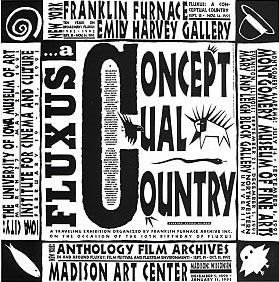
-Tristan Tzara, "Authorization, New York Dada," New York, 1921.
Long, long ago, back when the world was young ... Fluxus was like a baby whose mother and father couldn't agree on what to call it ... Fluxus has a life of its own ... When you grow up, do you want to be a part of Fluxus? I do.
-Dick Higgins, "A Child's History of Fluxus," New York, 1979.
Fluxus pt 2

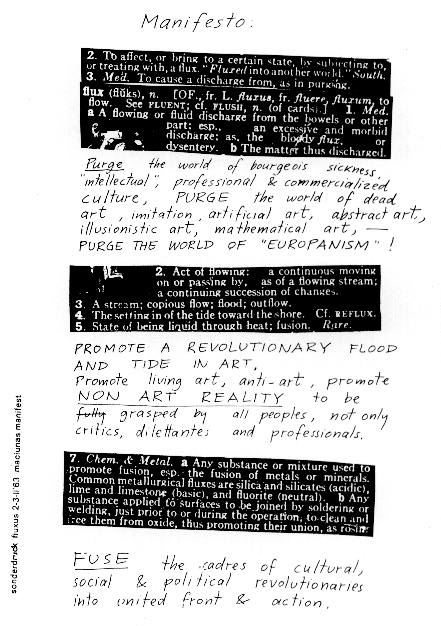
Fluxus “happens when one feels that life and art must be taken so seriously, that it becomes impossible to take life or art seriously.”
1) Fluxus makes the mundane magical.
2) Fluxus happens when one feels that life and art must be taken so
seriously, that it becomes impossible to take life or art seriously.
3) Ordinary acts and ordinary objects perceived in extraordinary ways
Alternative Space & Redux.
Redux and the organisation of dirt.
Questioning notions of typical gallery space, a reconstruction of Giorgio Sadotti's Dinner Party, originally held at Cubitt Street Gallery in 1996.
"®edux re-presented the event with different guests and performance, in a setting whereby the guests were part of the performance. The unnerving quality of these power brokers in an alternative ‘dirty’ space, set the agenda for subsequent events, and a radical approach to how exhibitions are set in terms of art world etiquettes of behaviour." -Peter Lewis
Questioning notions of typical gallery space, a reconstruction of Giorgio Sadotti's Dinner Party, originally held at Cubitt Street Gallery in 1996.
"®edux re-presented the event with different guests and performance, in a setting whereby the guests were part of the performance. The unnerving quality of these power brokers in an alternative ‘dirty’ space, set the agenda for subsequent events, and a radical approach to how exhibitions are set in terms of art world etiquettes of behaviour." -Peter Lewis
What is curating?
-How do we formalise something which is an informal practise?
-Theory and practise - impacts as variegated and dependent upon interests of intended 'group'.
-Perspectives in curating.
-Alternative curatorial practises, concerning IDEAS OF REPRESENTATION OF OBJECTS OUTSIDE THE SPHERE OF THE MUSUEM SPACE.
-Theory and practise - impacts as variegated and dependent upon interests of intended 'group'.
-Perspectives in curating.
-Alternative curatorial practises, concerning IDEAS OF REPRESENTATION OF OBJECTS OUTSIDE THE SPHERE OF THE MUSUEM SPACE.
Beyond 'Beyond Interface': Art in the Age of Ubiquitous Networking - Medialab-Prado Madrid
Beyond 'Beyond Interface': Art in the Age of Ubiquitous Networking - Medialab-Prado Madrid
In the now-historicized first epoch of net.art, the Internet was a para-site for the protocols and viruses of a new form of art. net.art proposed radical shifts in the production and reception of art, and to a significant degree these parallel tracks purported to converge on the horizon of the Interface in a participatory consumation of artist and audience. A funny thing happened on the way to this future, however. It kept receding. Into new devices. New metaverses. Into ubiquity, arguably.
... the notion of art in an age of ubiquitous networking and whether this constitutes a second epoch of net art or network practice or something else. Art after networks?
In the now-historicized first epoch of net.art, the Internet was a para-site for the protocols and viruses of a new form of art. net.art proposed radical shifts in the production and reception of art, and to a significant degree these parallel tracks purported to converge on the horizon of the Interface in a participatory consumation of artist and audience. A funny thing happened on the way to this future, however. It kept receding. Into new devices. New metaverses. Into ubiquity, arguably.
... the notion of art in an age of ubiquitous networking and whether this constitutes a second epoch of net art or network practice or something else. Art after networks?
Caroline Langill, Shifting Polarities : Electronic media in 1974

Vera Frenkel, String Games: Improvisations for Inter-City Video, 1974-2005
Radical Diversity - the confluence of art and the Internet - Medialab-Prado Madrid

Radical Diversity - the confluence of art and the Internet - Medialab-Prado Madrid
Current, popular definitions of net art do not describe the plurality of approaches and methods artists have used and still use. They have become limiting obstacles that block our view of this wonderfully complex terrain of mixed conceptual and material art practices. Mainstream art discourse generally fails when assessing net art by confusing it with web art. At the basis of this misinterpretation lies a lack of knowledge of even the basics of new media.
...we should not follow such temporary projections and misinterpretations. By escaping from the trap of fitting ourselves into any net art cliché we have the chance to re-evaluate both past and present art practices. This re-evaluation needs to include a proper interdisciplinary approach, which reaches beyond a purely literary, conceptual art criticism.

The Internet and Art.
Interesting article by Jon Ippolito.
The internet is such a rapidly growing and influential element of contemporary culture. How do we explore the internet as a medium for art? Can it function as a process for making art or is it merely a platform for display and curation.
The internet is such a rapidly growing and influential element of contemporary culture. How do we explore the internet as a medium for art? Can it function as a process for making art or is it merely a platform for display and curation.
07/03/2010
06/03/2010
Context Responsive Curation:
The Organisation of Dirt.
'An assumption that traditional approaches to visual display are inadequate in the context of marginal, orphaned, ephemeral, and raw spaces'.
The curation of ideas as well as spaces.
'An assumption that traditional approaches to visual display are inadequate in the context of marginal, orphaned, ephemeral, and raw spaces'.
The curation of ideas as well as spaces.
Subscribe to:
Comments (Atom)